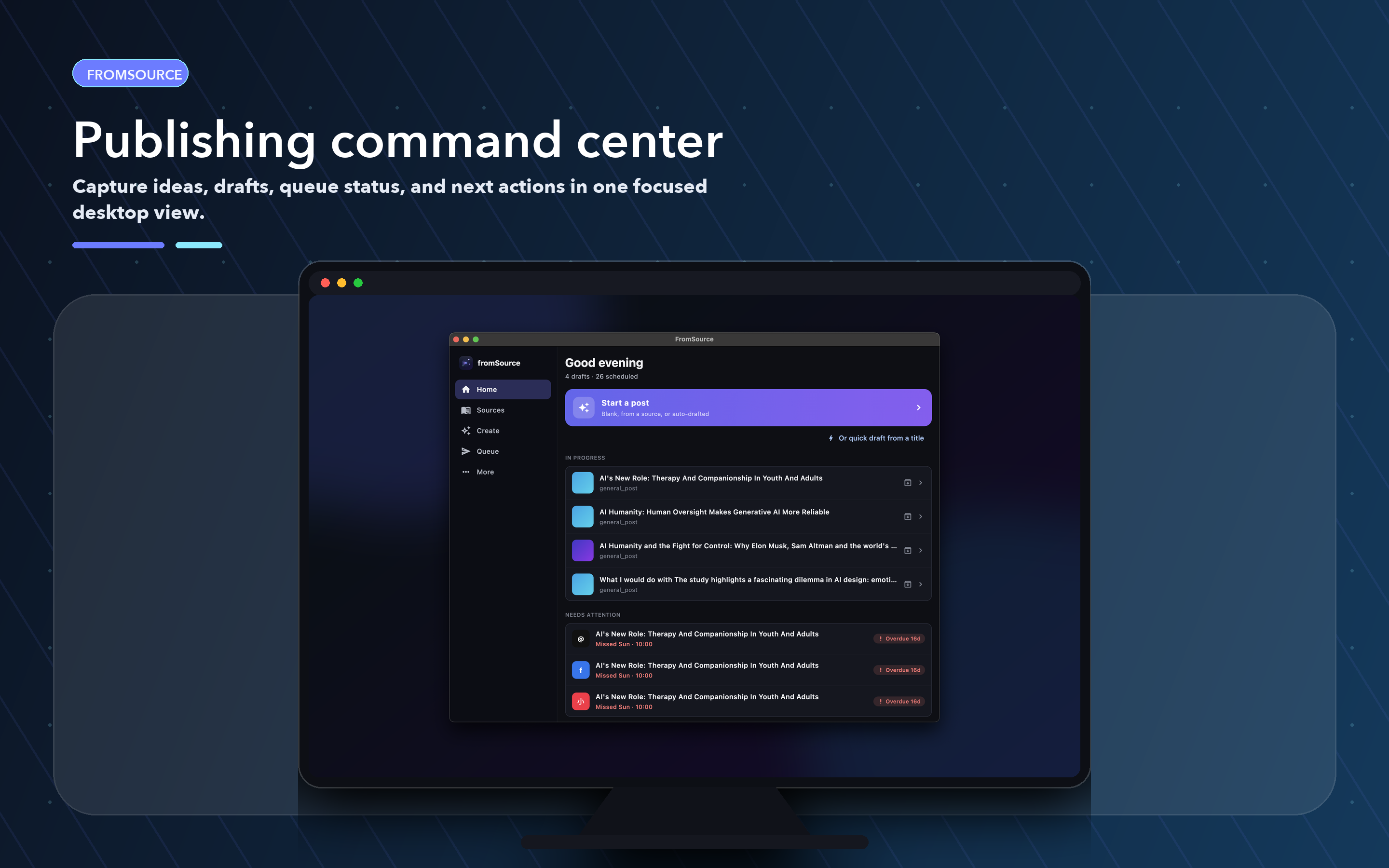
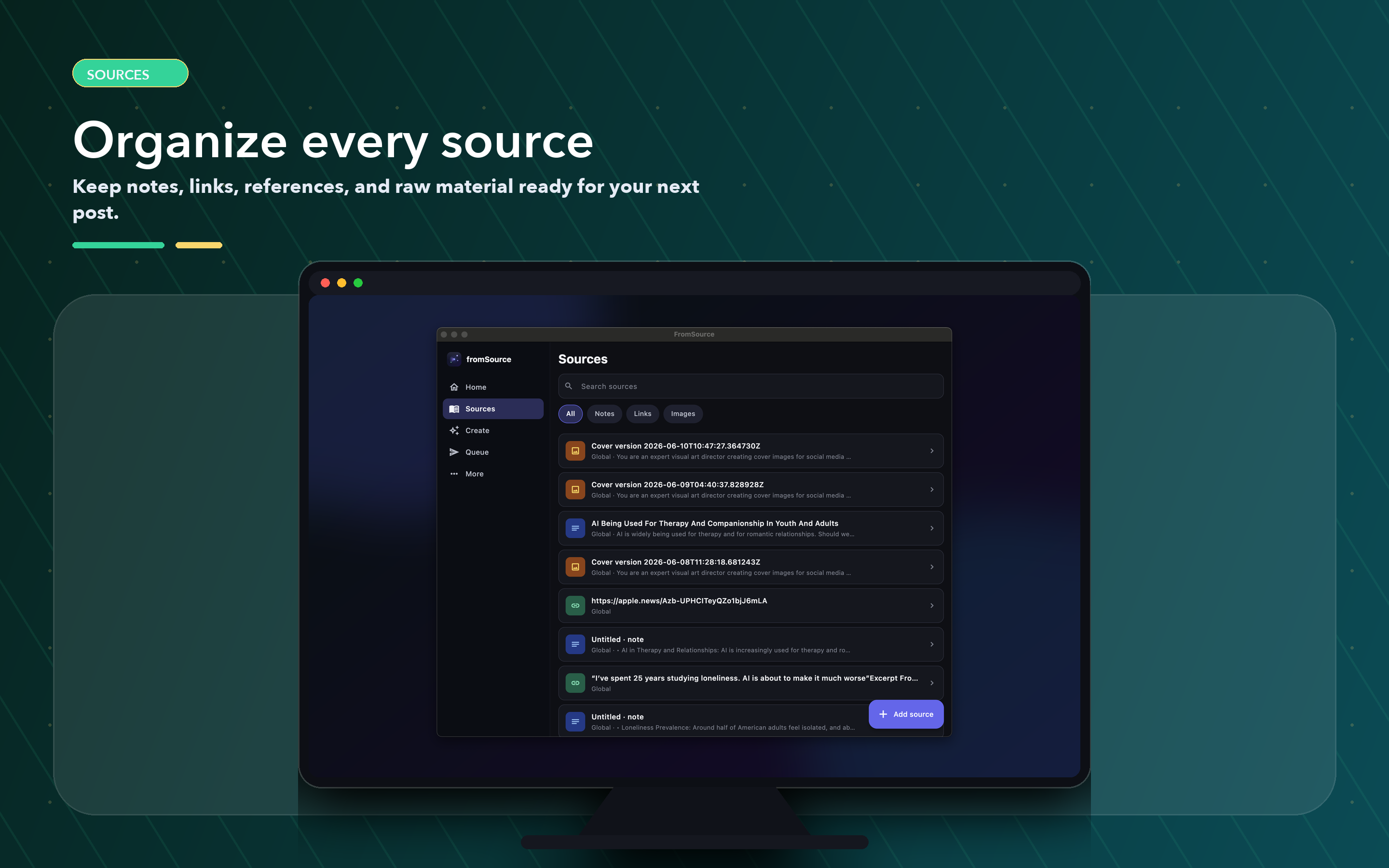
AI writing from real source material

Turn notes, links, and screenshots into posts
that still sound like you.

FromSource turns saved source material into publish-ready drafts and platform variants without flattening your voice. Grounded in sources, tuned for tone, reviewed by a human before anything goes live.

Start from sources instead of a blank box Learn your voice from accepted writing Human approval before anything publishes
Get Early Access → See How It Works
𝕏 X in LinkedIn ▲ Reddit f Facebook Pages ▶ YouTube
FromSource — Source Flow
Wizard
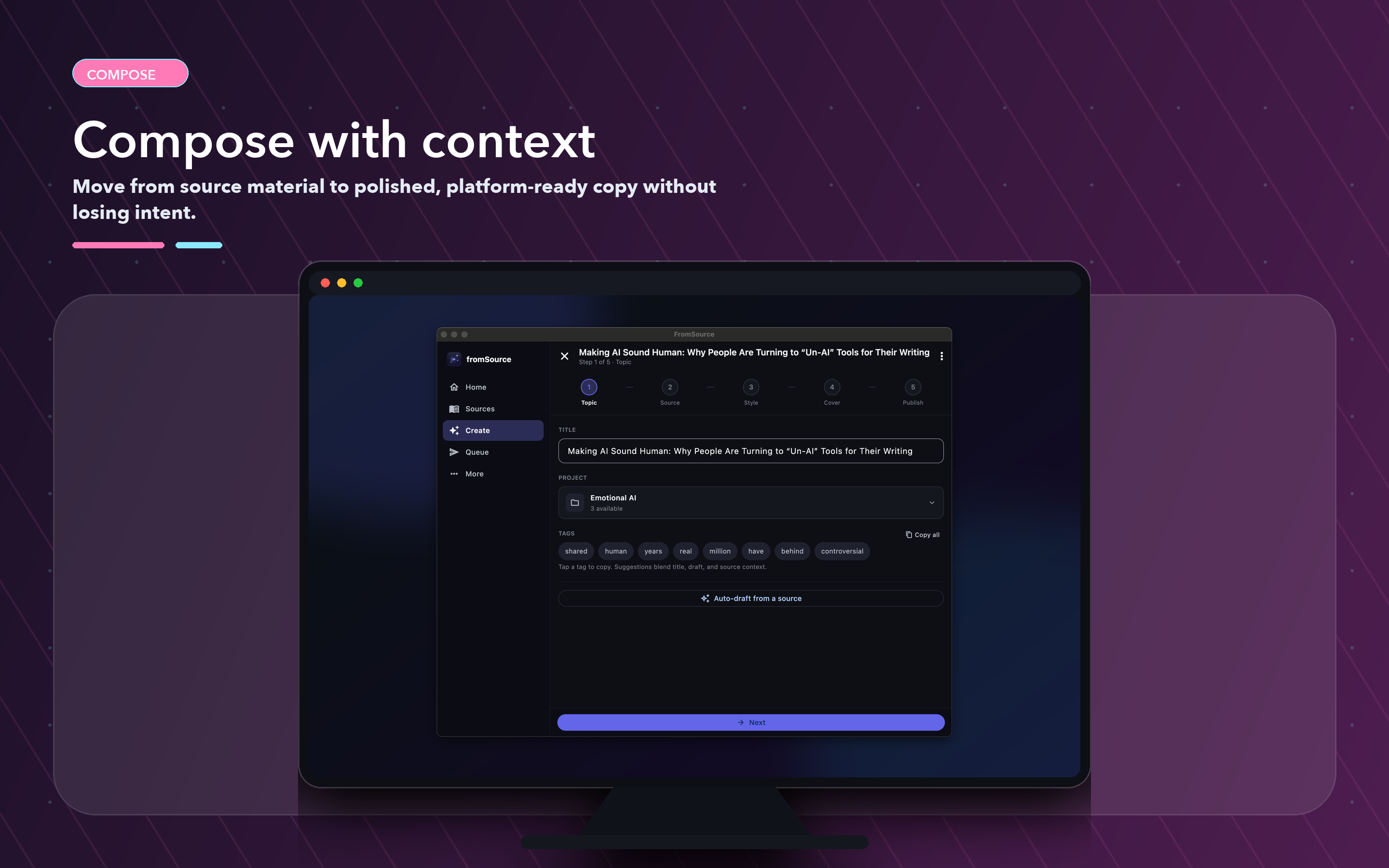
01 Project + Post
02 Sources
03 Canonical Draft
04 Variants + Covers
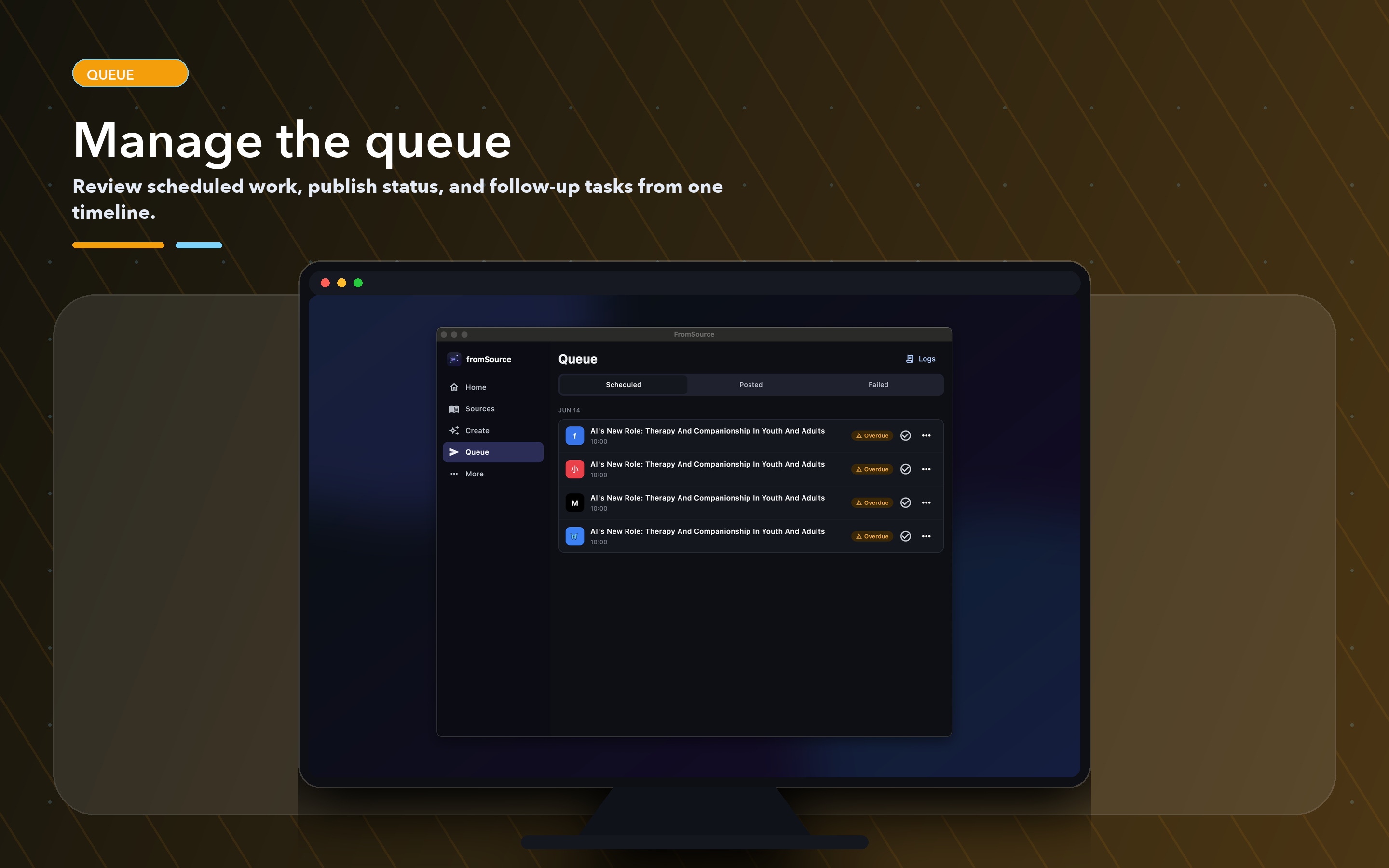
05 Queue Review

Automation
▶ Tue 09:00 run
✓ Awaiting review
Voice Agents / Why emotional coherence matters in AI systems
Wizard step 4 of 5· Emotion signal: curiosity + conviction ·Review-ready
Canonical Draft LinkedIn Reddit Facebook Pages ▶ YouTube
Source set: note + paper + screenshot.

Canonical angle: why emotional coherence matters in production voice agents.

Style pass keeps the draft direct, grounded, and emotionally coherent with the point being made.

Next action: queue 4 variants or send to human review.
✦ Emotion-aware style pass complete ✓ Automation provenance attached
Source-grounded
Notes, links, screenshots, and files stay attached to the draft
Voice-aware
Accepted writing teaches the system how you actually sound
Platform-native
One canonical draft reshaped for each destination without copy-paste filler
Human-approved
Automation prepares the work; you make the final call
Interactive Demo

Try the workflow.
See source-to-post in under a minute.

Turn raw notes, links, and screenshots into a review-ready post package. Grounded in source material, tuned for voice, and still human-approved before publish.

Scripted demo Live backend next
Try the workflow Scripted demo Ready
One scenario. Real workflow shape.
1 Source Pack

What the post starts from

3 sources selected
Note Ops note

Queue rewrite result

Queue rewrite cut p95 publish latency from 11.2s to 6.9s. Biggest gain: fewer duplicate retries.

Link Retrospective

Incident write-up

Retries amplified backlog under load and masked the real bottleneck during peak queue pressure.

Screenshot Chart caption

Latency chart

p95 latency before and after the queue rewrite across a 14-day window, with failure spikes removed.

2 Canonical Draft

What our queue rewrite fixed

Goal: explain a real infra improvement without sounding like a launch thread Audience: operators, founders, and builders

Pick the source pack, then build one clear source-of-truth draft.

The point is not autoposting. The point is moving from evidence to a post package without losing the real story.

Build the draft to reveal the canonical post, then polish it for voice.
Provenance
Sources stay attached Voice polish comes next Human review still required
3 Platform Variants

Adapt the same idea with intent

Outputs locked until draft exists
Platform output preview
0 chars

Generate variants to see the same idea compressed for X and expanded for LinkedIn.

Review state
Source-linked
Voice-polished
Platform outputs ready
Human approval required before publish
Workflow Example

One real idea.
Three connected states.

This is the point of the product: the source material stays attached, the canonical draft stays clear, and the final variants stay traceable back to the original thinking.

01 — Source Pack

Start with actual material

No blank page. A post begins with saved evidence, notes, and context inside the right project workspace.

Paper GoEmotions / emotional coherence notes tagged to the Voice Agents project
Founder note "Users react to latency and tone before they can explain why"
Screenshot Conversation artifact showing where wording was accurate but the response still landed wrong
02 — Canonical Draft

Shape the core idea once

The wizard builds one canonical draft, then the style engine tightens voice, phrasing, and emotional weight before anything gets adapted.

Angle Why emotional coherence matters more than raw model accuracy in production voice agents
Style pass Direct, founder-voiced, emotionally aligned with the argument, and free of banned filler
Review state Queue-ready package with provenance, checklist, and human approval still intact
03 — Platform Outputs

Adapt with intent

Variants stay native to each network while still pointing back to the same underlying idea and source chain.

X Compressed into a direct founder take with a thread-ready opening claim
LinkedIn Restructured into hook, supporting points, and discussion CTA for a broader professional audience
Reddit / Facebook / YouTube Context-first discussion, accessible page version, or metadata bundle when the idea anchors a video
Core Features

The workflow, not just the composer.
Built around how source-driven writing actually happens.

Built local-first for macOS and iOS. Capture source material, shape a canonical draft, refine it for voice, then turn it into platform-ready outputs under human control.

📥

One-Click Capture

Capture links, notes, files, screenshots, and share-sheet inputs with source provenance attached from the start.

🧠

Project-Scoped Context

Projects, post workspaces, inbox, library, queue, and history stay in one system so context compounds instead of scattering.

✍️

Wizard Flow

The default path: pick a project, add sources, generate a canonical draft, create variants, then queue the review-ready package.

🎙️

Style Engine

Style controls, exemplars, banned phrases, and emotion-aware adjustment help the output land with the right voice and weight.

📡

Automation

Auto Mode can discover topics, draft posts, build variants, and package outputs for review on a recurring schedule.

📦

Bundles + Variants

One canonical draft can become platform-native outputs and coordinated bundles without rewriting from scratch.

Explore All Features →
Why it sticks

Designed to create fast trust.
Then compounding leverage.

Project-first

Source, draft, variants, queue, and history stay attached to the same project and post workspace. The product remembers what the idea was actually about.

01
Context compounds
No broken chain between source and publish
Emotion-aware

The style engine does more than tone sliders. It detects emotional signal and helps adjust cadence, emphasis, and phrasing so drafts do not come out flat or off-key.

02
Keep your voice
Learn from accepted posts, not generic templates
Human-in-the-loop

Automation does the prep work: topic discovery, draft packaging, variants, covers, and run logs. Final publish still stays with the human operator.

03
Automate the prep
Keep approval and accountability
FAQ

Answer the real objections.
Before the signup form.

Most people with real source material do not need another scheduler. They need to know whether this will fit their workflow, keep their voice, and stay under human control.

Is this another social scheduler?
No. The wedge is source to post. FromSource keeps project context, source material, canonical draft, variants, queue, and history connected. Scheduling is downstream of the actual writing system.
What does automation actually do?
Automation can discover candidate topics, package drafts, generate variants, and prepare review-ready runs on a schedule. Final publish still stays with the human operator.
How is the style engine different from generic AI rewrite tools?
It does not just paraphrase. It uses your accepted posts, exemplars, banned phrases, project overrides, and an emotion-aware model to adjust tone, cadence, and emotional weight so drafts land closer to your actual voice.
Who is this built for first?
Founders, operators, and expert-led teams posting from real work. Best fit: people who save links, notes, screenshots, and product lessons all week, then need a fast path to platform-native posts that still sound human.
Join the Waitlist

Build from sources.
Publish with a system.

Join the waitlist for early access to the macOS and iOS launch. Built for people who already have notes, links, screenshots, and ideas, but want AI writing that still feels like them.

No spam. No autopublish without review.

FromSource · macOS & iOS · Local-first · Private by default